Showing posts with label comic books. Show all posts

Tuesday, February 9, 2010

Goth-Emo Teen Angst Sucks In Bookish 30-Somethings!

Oh, Wet Moon. So angsty and drama-filled. I adore it. I love Ross Cambpell's pudgy little characters with the big eyes and the confusion about their love lives. I love that the most tomboyish main character (beloved Trilby) is also the only outright straight female main character. I love the weird side stories and the feeling that they're all on the point of converging. I honestly cannot put a Wet Moon book down after I open it until it's finished.

So, this is the first time I've reviewed a Wet Moon book on this blog, apparently, and I feel the need to give a little background on it. First of all, it's a comic book/graphic novel series about (mostly) college students in a small Southern town called Wet Moon. The art and culture are very emo-goth, and there is a lot of sexual tension and sexual orientation exploration. It doesn't get too explicit, but it does get sexy, and it's heavy on the bi- and lesbian relationships. My husband introduced me to it, I think because he read the first one and loved it and was confused about why he liked it so much. I read it and also loved it, and then we had a long conversation about the fact that it's so much teenage angsty popcorn fluff, but there's something more to it. And the artwork is flat-out gorgeous.

So our main characters are four high school friends: Cleo (who is probably best called the heroine), Trilby, Audrey and Mara. But the cast of characters seems to grow exponentially with every book, so that I could now name for you probably at least 20 other characters who are also of some significance. Their lives and relationships intertwine, they whine about not getting dates or not knowing who to date, they buy atrocious Hot Topic-style clothing and get tattoos and piercings...it all sounds really mundane, but it is reading crack, I promise you. The first three books really introduce the characters and their relationships and backgrounds - they lay the groundwork. Things started getting weird in the 4th book - a significant character shows some serial killer tendencies, a masked vigilante shows up, there's statutory rape drama and a cat who disappears through weird inky holes in the floor...and then the 5th book just gets weirder. Now, all of the mundane drama stuff still goes on, but there's some David Lynch-like weirdness too. I love these books, and I'd love you to love them too!

So Volume 5, Where All Stars Fail to Burn, is where the shit starts to go down. Things start happening faster. We watch Cleo kinda sorta start to fall in love with a close friend, and also deal with her sister Penny's big secret. We watch Trilby and her geektastic boyfriend, Martin, be just outright adorable, and Martin gets to meet Trilby's parents. We watch Audrey finally stand up for herself. Myrtle becomes even more psychotic, and Fern becomes even more unbelievably weird. We still don't know who the masked vigilante is, though I've got some theories going. And of course, we get to see the big softball game. Campbell, that incredibly talented SOB, leaves the book with a heart-breaking killer of a cliff-hanger - I almost fell out of my airplane seat in shock that he would leave the story like that FOR MONTHS! Until the next book comes out! ARGH! It sets my teeth on edge just thinking about it, even now, and I read this book two and a half months ago!

Bottom line, 5 stars. I cannot get enough of this series. It's killing me that I might have to wait a whole year for the next one. Damn you, Ross Campbell!!!

Friday, August 28, 2009

A Funny Name and an Excellent Story

Well, crap. I just wrote a whole, long beautiful review of this and it DISAPPEARED. For no apparent reason. I'm mad and sad at the same time. But I'll try to recreate to the best of my ability...

This is an incredible book. And I don't mean, "incredible for a comic book." While it is a graphic novel, Asterios Polyp is a better book than 80% of the prose books I've ever read in my life.

It's a fairly simple story when boiled down to its basics. A man, our hero Asterios, has a broken heart, and it's really his own fault. So he's depressed and miserable. Then he goes through some mental and spiritual rejuvenation in a small town where he happens to get off the bus. And then he goes and tries to get back his girl.

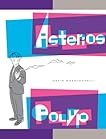
The genius of the book is in its construction. Everything is laid out in dualities. The book uses two main colors, as you can see from the cover image. The story is told in segments alternating between the present and the past. The narrator is not Asterios himself, but his twin brother Ignazio - who died at birth. And there is imbedded in the story some literal discussion of duality in architecture and design, in art, in science, in human nature, in the universe. Layered on top of all of this duality is the Greek tragedy of Orpheus and Eurydice, acted out in the persons of Asterios and his love, Hana, and also making a literal appearance in the story when Hana becomes involved in an actual production of Orpheus, the musical. Add to all of this some insights into the nature of architecture and design, told in a story constructed in an architectural manner and through artwork that is the epitome of good design, and you have a pretty complexly constructed book.

That brings me to the art. The very colors used in each scene are weighted with meaning. In a book where even the colors have such significance, you can guess how important the rest of the artwork is. It's very modern - in a late-'50s/early-'60s kind of way - and very focused on high design. The lines used to draw the characters are frequently used to give the reader insight into their personalities, even when they are minor characters. I have never read a book where the art was so important to understanding the moods, personalities, even souls of the characters.

This book was just amazing. It touched my heart; it made me think; it made me laugh; it made me slow down and study the art; it's stayed with me for weeks. I want to read it at least 10 more times in my life. And I'd highly recommend anyone else do the same. I'd give it 6 of 5 stars if that were possible.

Wednesday, June 3, 2009

My Father Bleeds History, and Here My Troubles Began

Maus is a two-volume comic book memoir written by the son of Auschwitz survivors, about their story of survival and also the author's story of his somewhat difficult relationship with his dad. (An aside here - I had a hard time coming up with that first part, because I didn't want to say "graphic novel" [it's not a novel] and "graphic memoir" sounds like a Penthouse exclusive, and "comic book memoir" sounds kind of dumb, but it's the best I've got. ) As the inside flap of the book says, it's a story about the Holocaust and also a story about those who survived the survivors.

We've all seen/heard/read a million stories about the Holocaust at this point. It's horrible and heart-breaking every time. It never gets easier to witness in any way, largely I think because most people have a very difficult time imagining how anyone could treat another person in that way. People have treated other humans as animals or worse throughout history, and it still goes on today (which is partly why the stories are still so relevant and raw), so I know the attitude is certainly within the human capacity...but I don't understand it. Spiegelman ups the ante a little by depicting the characters as animals already - the Jews are mice, the Nazis are cats, the Poles are pigs, the French are frogs, the Americans are dogs, etc. It eliminates the hackneyed cliche of "treating people like animals" and it also makes you view the story with fresh eyes because it's told a little differently than usual.

As for style, I thought Spiegelman's style of story-telling was very similar to that of Harvey Pekar (of American Splendor fame), which is to say it's very common man, it's a little self-deprecating at times, it breaks the fourth wall on occasion...and something else intangible that I can't describe. I love Pekar's work, and I love this as well. It's hard to choose which parts of the books I liked most. The moments between the author and his father in the present are so realistic, rotating among frustration/anger at his father's irritating habits and attempts at guilt/manipulation, and worry/tenderness over his father's advancing age and physical/mental deterioration, and admiration for the strength and ingenuity his father had in order to survive the Holocaust.

On the other hand, the historical parts about Vladek and Anja in Poland and the many hells they went through to come out again alive and to find each other were so poignant and gripping - those were the parts that were impossible to put down. I'm still affected by this, two days after I finished the books - I have tears in my eyes as I type, thinking about all the people they lost, including their first son, and all the terrible things they saw, and what an unbelievable miracle it was that they both survived and found each other after they earned their freedom (because they were separated in Auschwitz and didn't see one another or hear from one another for a long time).

It's an incredibly moving story told in a somewhat unconventional manner. It has won several awards and a great deal of recognition. All well-deserved, in my opinion.

Friday, March 13, 2009

Learn to Love Comics: Transmetropolitan

Okay, okay - I suck a little bit. I've already broken my promise to update the blog at least weekly. I was out of town for a girls weekend at the beach last weekend, and spent most evenings this week trying to desperately to catch up on my editing jobs that I would normally have worked on over the weekend. Tonight, I am tired, but I am caught up! So I'm back. I won't promise that I won't lapse again, but I'll do my best to prevent it.

On to the business of blogging. I know a lot of avid readers, absolute lovers of books, who look down their noses at comic books and graphic novels. I read some comics when I was younger, but I didn't really get hooked until I met the man who is now my husband. He is what you would call a comics FAN. Not like the comics guy on The Simpsons, he's not pretentious and dorky like that, but he does love the art form. He's turned me on to quite a lot of comics, and I would like to try and spread the love. Because comics aren't all superheroes and manga; there are a lot of great stories and characters out there, just the same as prose novels, even better than some prose. So here begins your education on some of my favorite comics - one title at a time.

I'm going to start with a great comic I love that has lots of snarky irreverence and social commentary - a series called Transmetropolitan, written by Warren Ellis. The series hero is Spider Jerusalem, a kick-ass gonzo-style journalist in a sort of cyberpunk future. The series starts off with Spider living as a hermit with no technology, no hygiene and no clothes on a mountain outside the big city. The problem is that he has a two-book deal for books he has not written that were due probably years ago, a publisher breathing down his neck for them, and he's spent pretty much his entire advance and has no more cigarette money. So he girds his loins with hatred, shaves his head and beard, puts on clothes and heads back to the city to write some articles again.

With the help of his filthy assistants, Spider fights the good fight, trying to expose the corruption and stupidity that is threatening to ruin the entire world (sound at all familiar?), hating his fellow humans and hating that he has to save them from themselves, but unable to stop himself doing something about it because it drives him so insane. He exposes complete idiots who are mutilating themselves in ridiculous ways in the name of fashion; he successfully exposes severe cases of police brutality and stops a riot; and he takes on his biggest challenge of exposing the evil represented by the jackasses running for public office in the big election.

I like Transmetropolitan because I identify so much with Spider Jerusalem. He gets so frustrated by the way people around him refuse to think for themselves, instead letting the ever-present media tell them what to think and what to do. He hates them for their laziness and stupidity, and yet he really wants to believe they don't have to be that way. I feel that way on pretty much a daily basis. The social and cultural issues that Ellis tackles are extremely relevant to our current sociopolitical situation, as all good sci-fi should be. And on top of all of that, it's irreverent and hilarious and beautifully drawn. I highly recommend the series to anyone who revels in sharp, snarky societal commentary and/or is a Hunter S. Thomspon fan. I love this series, and I think it should be required reading in high schools to hopefully shock some of those kids out of the lazy complacency our society seems to prize these days.